Lukas Koenig, a conversation at Jazzfestival Saalfelden #46
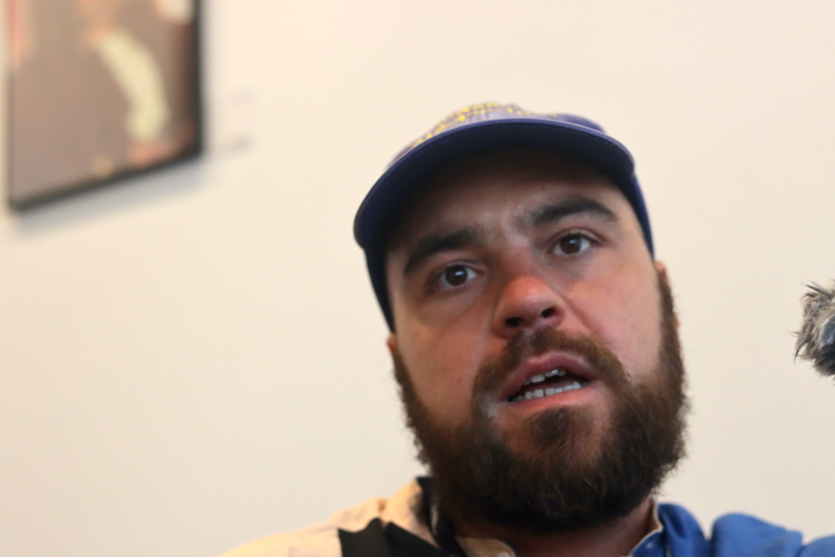
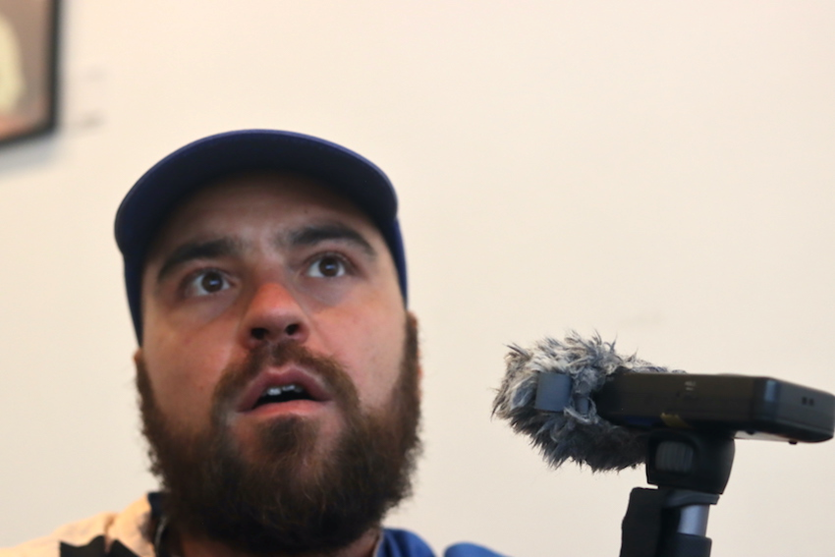
I had a delightful conversation with Lukas König, a fascinating Austrian drummer, composer, and improviser. He is considered one of Austria’s finest drummers and was formerly an artist-in-residence at Saalfelden.
During Jazzfestival Saalfelden #46, he presented his duo project with Leo Riegler under their new project name, “KönigLollipop”. They performed music from their new album, ‘Pantheism at Praterstern’, whose sound combines hip-hop, free jazz, and even elements of contemporary classical music.
König also gave a wonderful performance with Rob Mazurek and Erwan Keravec at the Kunsthaus Nexus stage as part of the Shortcuts series on the second day of Jazzfestival Saalfelden, Friday, August 21, 2026.
Where did you start and how did you discover that you loved drumming?
Lukas König: I'm coming from a very musical family. My father had a band with his brothers. A very important figure in my life was my grandfather because he taught me to play drums basically when I was five years old. He bought me a first drum set, and then gave me my first snare drum lessons when I was six, from 6 to 7 I went to his place every day. Every day we had a lesson about playing snare drum. That's how it all started.
He also had a marching band. I was always playing snare drum with that marching band in lower Austria, an hour from Vienna, near Sankt Pölten called Prinzerdorf. It's a small village. That's how it started.
When I was about ten years old, I went to the local music school and was taught to play the drum set. From then on I went to different workshops. There was a super nice workshop in Scheibbs, which is between Sankt Pölten and Linz. I came there when I was 13 or 14. When I went to the gymnasium in Austria, I was studying drums, basically jazz drums. I first studied in Vienna at a private conservatory and then I was going to the university in Linz at the Bruckner.
Super important was, you mentioned it already, the JazzWerkstatt Wien, it was a young collective in Vienna who made a festival, I think in the first two years it was 30 days in a row. They rented a space and just organised a festival and made their own lineups. At some point I kind of grew into this scene a bit and I enjoyed to go with them in a way. So that was the very beginning.
From then on, I was going to Switzerland for a year, that's where I met this amazing musician, Malcolm Braff. He's a pianist and he's still influencing me a lot with rhythm because he was investigating rhythm, we were basically thinking in two and three, in triplets and in eighth notes, so to say. He basically investigated rhythm so deeply that it's flawless. It's like you can see rhythm in a different way.
Then I started playing with his trio, with Malcolm and with Reggie Washington. That's when we started to investigate and play together and try to make this band sound, including this investigation in rhythm, which was super important to me. I'm still drawing from that. It's amazing. The release of ‘Inside’ (enja) was one of my first bigger releases. I played with him on different festivals and I was fortunate to be there with him as a really young lad.
Of course, in the meantime I also started to make my own projects. Yesterday I played here in Saalfelden with my old friend Leo Riegler. We work together for almost 20 years, and we have a duo called KönigLollipop and this is a super long project already.
There's also a very important band in my life as composer. It's with Martin Eberle, Manu Mayr, and Bennie Ommerzell. I formed another band called Mobcut with Audrey Chen and Julien Desprez and more and more and more and more...
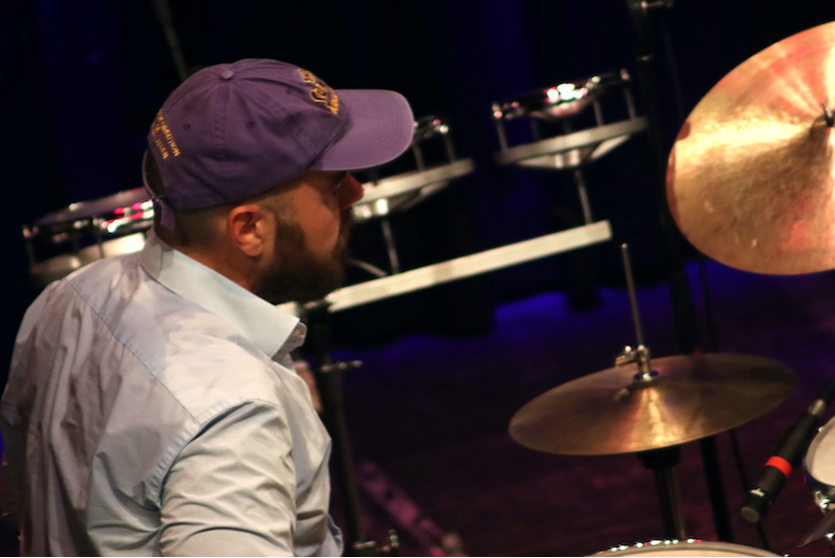
Jazzfestival Saalfelden is very important for me also because they supported me with everything from early on. With all my projects, with all my bands, they always said, "Ah, Lukas, I think you should do this.” A couple of years ago they also gave me the commission for the main stage. Mario Siedl is super supportive with my stuff. I'm very happy that he always invites me back. This is an amazing festival because here, I also met a lot of international people that I'm now playing with basically, on a regular basis. I'm happy that that worked out so well.
With regard to jazz and experimental music, how did you arrive at the music you make today? Who was your first guide or source of inspiration? Do you have a favorite or particularly influential musician? Does that person play drums, or another instrument? What do you find in their music, and why are you inspired or attracted to it?
Lukas König: As I said before, my grandfather was one of the first who showed me Gene Krupa and all this early drummers like Buddy Rich , … That was the time before YouTube. It's also funny because nowadays people can see everything on YouTube. I went to the drum store and bought a VHS to watch these drummers. That was first, because he was super into big bands. So he showed me that.
I remember when I was 10 or 12 in my music class in school, we had a music teacher who showed us a big variety of music, every day it was a different genre. At some point we arrived to funk and fusion. Funk was like Tower of Power, and fusion was Joe Zawinul and Weather Report. As soon as I heard that, I was overwhelmed. First of all, this funk thing, it's super dry. I was really into it. I'm still a big fan of Joe Zawinul and his music.
That music teacher gave me a CD from back then. It was my first kind of jazz or whatever that means, but it was Weather Report "830". That's the live album. I really was blown away. I had never heard such thing in my life before. And it was funny because it was at the same time that Billy Cobham was coming to..., I think Mel Gibson or something in a small cinema somewhere in the countryside. He was playing with his band and for me, that was free jazz. I thought: "wow, what is this? This is a really kind of weird saxophone", crazy stuff. That was a bit too wild for me. That was the reason that when I heard that '830' record first, from every part I only listened to 3 or 4 songs always in loop, and the other things were a bit, I don't know, it was too crazy for me back then, but that was for sure my entrance in this world. And of course, there's so much music.
Then I was listening to it, drum wise of course. One of the first that I really loved so much was the band Medeski, Martin and Wood. In the beginning I thought: "oh my God, this is the best. I love that drummer so much". This drummer is called Billy Martin and he was super influential for me. That was the time when I was listening a lot to John Zorn, also with Kenny Wallace. I was such a fan of Kenny. I'm still a very big fan of Kenny Wallace and Bill Frisell and all these people. And also through the festival here, I also saw all these things that I didn't know before. So that was the most influential, I would say in this way.
But it's funny because like we all do, I'm also changing a lot, at 20 years, I like this, now I like something completely different. I'm 38 now. It's funny, how you evolve and have different kin,ds of favorite music. Then you do your own stuff and also for me, it's always super important to do something new. I had a long time where I was a bit trying to reproduce things. I tried to play like Elvin Jones and other people. But at some point you realize, okay, there is already Elvin Jones, there is already Tony Williams, there's already Billy Martin and all these people. So you try to find your own language in a way. I'm super easily bored by stuff that I know already, and then by seeing people that are doing the same and I'm like, "come on, man, this is not..." I want the real, raw thing. So it always was getting more and more extreme that I really wanted, new stuff also, like for myself to listen, but also to create stuff that maybe I don't know anybody who did that before. That's why I started with this cymbal stuff. When I have a cymbal with a contact microphone on it and I'm going through an effect, guitar pedals and modify the sound and have drum triggers.
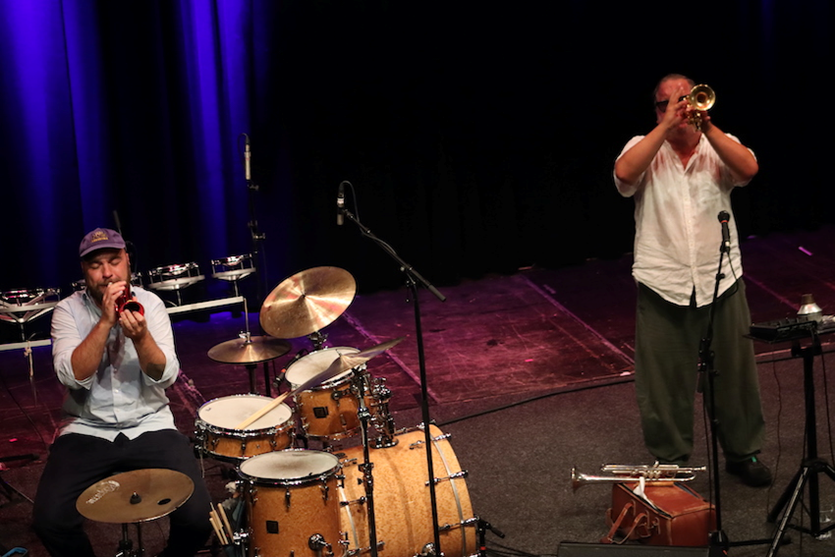
Today you were playing a trumpet…
Lukas König: Well, the trumpet is an old thing, because I actually started playing trumpet also with my grandfather when I was about eight. I never really developed so much further in my chops, but I still like to play it. And it was an honor to be able to play trumpet with Rob Mazurek today, because he's an amazing trumpet player.
You mentioned the concert you just performed, which was amazing. How did you meet these musicians, and why did you decide to play with them? Do you improvise the entire performance?
Lukas König: The thing was, basically I got a call from Mario Steidl, the boss of the festival. telling me. "Hey, Lukas, there is Rob Mazurek playing with Chicago Underground, and Evan Karavec is also playing his own stuff and with his band. And we should do a Shortcut concert at Nexus. Do you want to do that?" So, I reacted, "I'm a great fan of Rob and, and I also know Evan through a friend. Yeah, let's do it". And so we met today for the first time on stage. That was like an hour before the gig, we were setting up. Then Rob was asking me, "hey, was it you who put this together?" And I answered, "no, I thought it was you who put this together". And then we asked Evan: "Evan, did you put this together?" And he said "no". So it was actually Mario thinking about curating it.
And that happened already a couple of times in my life that Mario calls me and says "hey, Elliott Sharp wants to play a duo. Do you want to play with him?" And I'm like, "Of course. I mean, it's amazing ", and I'm super grateful that he's doing that always with me.
So, we met today and played this gig and everything was improvised, from the beginning till the end. It was really special because, how often do you play with a bagpipe player? I never played with a bagpipe player before in my life. And it's really cool. It's a really different palette of sounds. And also Rob has his own palette of sounds, these amazing sounds. I was super happy and I bring my own, at this point sometimes when I have an opportunity like this, then I'm playing both drums and also this hybrid amplified cymbal, as I call it. And the trumpet,...
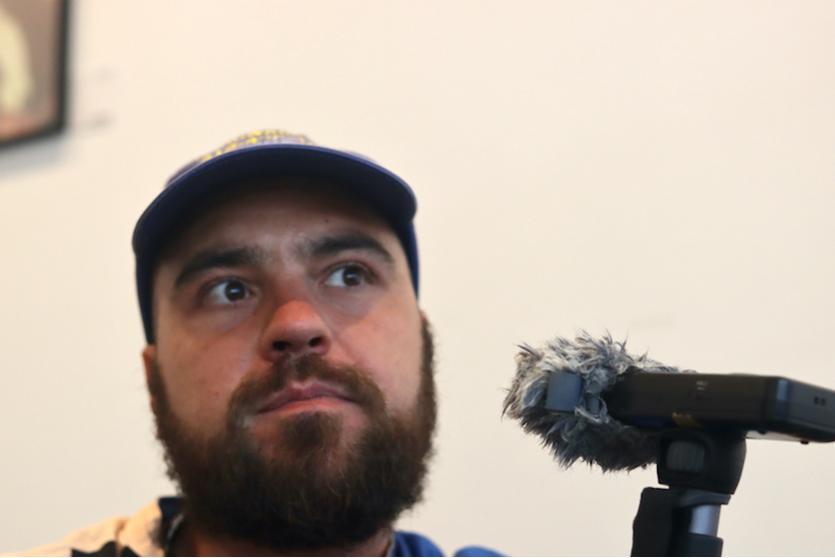
Why did you choose to play trumpets and bagpipes? The three of you were all playing wind instruments...
Lukas König: Basically, I used the trumpet because yesterday I played with my friend Leo and I'm playing also a little bit of trumpet with him. So, I had the trumpet already on stage and I left all my stuff on stage last night. When we arrived this morning, Rob asked "who's pocket trumpet is that? " And I said that it was mine. He said: "oh man, you have to play that thing too". And basically in the last few seconds at the encore, I was thinking "I'm gonna do this now". So I picked up the trumpet and played.
You mentioned a musician at the beginning whom I would like to ask you about. He is an institution—perhaps worldwide—in the realm of bass and low frequencies. I believe he is from New York and plays both electric and acoustic bass. You mentioned that you met in Switzerland, when he was living in Brussels, and that this was how your relationship with Reggie Washington began. Where and how did you meet? Do you still play together, or do you have plans to collaborate in the near future?
Lukas König: As I mentioned before, I was going to Switzerland to study with Malcolm Braff. He was putting together this band for his album ‘Inside’. He wanted to have a bass player who is, familiar with odd meter stuff and kind of funky, and was thinking of Steve Coleman stuff. That's why he was thinking of Reggie Washington and he said, "Reggie is in Brussels and let's do this band with Reggie".
The first time I met Malcolm was in Linz because there was Martin Štěpánek. He organized a workshop with Reggie, with ERV, with JT Lewis and with Malcolm Ruff. That’s how I met them all for the first time. Afterwards he was putting together this band. Reggie Washington is a legend basically, a bass legend. I was super grateful and happy to be able to play with him. And it was amazing to grow together and play a lot together.
At some point the trio stopped playing. There's only one recording of it's called ‘Inside’. Every time he comes to Vienna, I'm seeing him and it's super nice. Now he has his new huge band. I saw that they are doing a Roy Hargrove tribute band again and that's amazing. Now that you mention Belgian musicians, I also was at the Jazzfestival Saalfelden and I had my commission. I think it was in 2024. I also invited Farida Amadou. She's from Liege, originally, and she lives in Brussels. I invited Farida, she's an amazing bass player too. She invited me back for a project that she made last year in Amsterdam, in Weimar. So she had a huge project with two drummers and with Lotte Anker, Achilles Navarro and Marta Varela. And it was beautiful. I love to work with her, so there's a little bit of a Belgian exchange somehow.
Returning to Belgium: You mentioned that you will be playing there—in Antwerp, is that correct?
Lukas König: Yes, I'm going to play next week at the end of August at the Summer Bummer Festival in Antwerp. And it's a great lineup. I've just played in Brussels with my band Mobcut with Dalek, a rapper. Every now and then I'm happy to go back to Belgium.
What are your future plans in terms of new projects, solo work, collaborations, recordings, or tours? What is coming up?
Lukas König: There's a lot coming up. Last year I played with a piano player called Kasho Chualan. She's Kurdish and lives in Vienna. We recorded an album now and it's going to be finished soon. That’s the next release. Maybe I'm making a mistake, but there's like a lot of stuff coming out. There's also one with my first band, Kompost, that we will release soon. We just recorded it.
Also I'm part of a pop band, I'm playing percussion and synthesizer with an Austrian pop band called Bilderbuch. We're going on tour in the fall. And of course, I have my band Bobcat featuring Dalek. Dalek is a great rapper from New York, and we are touring in September in Vienna, in Poland, in Prague, Bratislava and Italy.
And then I have another band called The Sleep of Reason Produces Monsters. It's a quartet with Mariam Rezaei, Mette Rasmussen, Gabriel Miceli, and we have a lot of shows coming up in October in France.
What direction are you taking with your music? Is it becoming more experimental?
Lukas König: That's kind of experimental. It's a crossroad between experimental and free jazz, but also sound art, it's super diverse and it's really hard to talk in short about this band especially, but it's with turntables, electronics, trumpet, Mette is playing saxophone and I play drums and synthesizer also.
What do you think about the possibility of identifying a distinct Austrian jazz sound? Do you think there is such a thing as Austrian jazz?
Lukas König: That's a hard question. There's a lot of really important Austrian musicians that were shaping, of course, the whole scene. There's Wolfgang Puschnig, Joe Zawinul, Hans Köchler, Karl Razer, Karl Ritter. But there are also many others... Franz Hautzinger, Otto Lechner, and Harry Pepper. There are so many amazing players. And of course, the classical scene also swaps over the whole contemporary music scene. There's a really good, cool scene in Austria with musicians in general, not only jazz musicians.
We also have an interesting mix of literature and poets and also Dada, like weird people basically. So you have a weird mix of Austrians somehow who did great stuff. Then Wolfgang Puschnig, for example, he had this one album called ‘Alpine Aspects’ where he collaborated with an Austrian marching band, but then also with Americans, really important amazing musicians. And so I don't know, for me, it's like Austrian jazz, I don't know. Sometimes, when you think about cultural appropriation, it's a bit hard for me to be patriotic about something. So I'm a bit careful with that. But even now there are amazing players. You have young, amazing musicians also, inventors, instrument inventors s.a. Georg Vogel.
There are so many I could name now 50 people, so there's a lot happening. And also in Vienna especially, there's a lot happening in the whole electroacoustic field. So it's a nice mix of things.
Do you have any future collaborations planned with musicians from Latin America, perhaps from Mexico? I’m taking the liberty of asking because it would bring a different flavor and a different approach. Of course, there are influences that we share, but there are also the roots of folk and Indigenous music…
Lukas König: Yes.
This is something that happens a lot, especially in contemporary Argentina and Chile, where the Mapuche people have their own music and instruments...
Lukas König: I also like. I know it through my friend Julian, who did a lot in Brazil. And with the dance, there are some special dance steps and he translated that with guitar pedals. So, I'm playing with one Brazilian bass player, Vini Cajado. He's great. And, otherwise I don't know so many South American musicians, but, I'm always openminded. So there's one other person, Ximena Bedoya. She's from Peru, I believe, and she's experimenting with pedal steel guitar with objects. She's living in New York so I'm also super interested in going and maybe do something with her. We recorded already something and so maybe…
Text and Photos © Federico Garcia
Other
In case you LIKE us, please click here:


Foto © Leentje Arnouts
"WAGON JAZZ"
cycle d’interviews réalisées
par Georges Tonla Briquet

our partners:






Luchthavenvervoer zonder stress
Hotel-Brasserie
Markt 2 - 8820 TORHOUT
Silvère Mansis
(10.9.1944 - 22.4.2018)
foto © Dirck Brysse
Rik Bevernage
(19.4.1954 - 6.3.2018)
foto © Stefe Jiroflée
Philippe Schoonbrood
(24.5.1957-30.5.2020)
foto © Dominique Houcmant
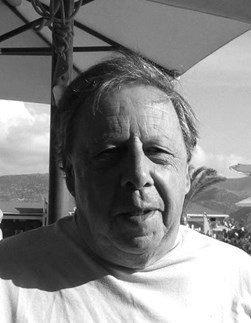
Claude Loxhay
(18.2.1947 – 2.11.2023)
foto © Marie Gilon
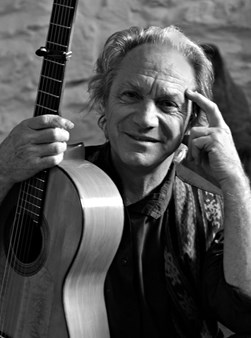
Pedro Soler
(8.6.1938 – 3.8.2024)
foto © Jacky Lepage
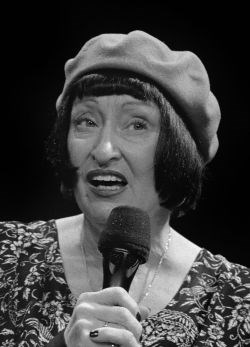
Sheila Jordan
(18.11.1928 – 11.8.2025)
foto © Jacky Lepage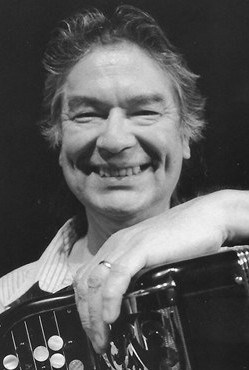
Raúl Barboza
(22.5.1938 - 27.8.2025)
foto © Jacky Lepage
Special thanks to our photographers:
Petra Beckers
Ron Beenen
Annie Boedt
Klaas Boelen
Henning Bolte
Serge Braem
Cedric Craps
Luca A. d'Agostino
Christian Deblanc
Philippe De Cleen
Paul De Cloedt
Cindy De Kuyper
Koen Deleu
Ferdinand Dupuis-Panther
Palma Fiacco
Anne Fishburn
Federico Garcia
Jeroen Goddemaer
Robert Hansenne
Serge Heimlich
Dominique Houcmant
Stefe Jiroflée
Herman Klaassen
Philippe Klein
Jos L. Knaepen
Tom Leentjes
Hugo Lefèvre
Jacky Lepage
Olivier Lestoquoit
Eric Malfait
Simas Martinonis
Nina Contini Melis
Anne Panther
France Paquay
Francesca Patella
Quentin Perot
Jean-Jacques Pussiau
Arnold Reyngoudt
Jean Schoubs
Willy Schuyten
Louise Stubbe
Frank Tafuri
Jean-Pierre Tillaert
Tom Vanbesien
Jef Vandebroek
Jean-Marie Vandelannoitte
Geert Vandepoele
Guy Van de Poel
Cees van de Ven
Donata van de Ven
Maurits van Hout
Harry van Kesteren
Geert Vanoverschelde
Roger Vantilt
Patrick Van Vlerken
Marie-Anne Ver Eecke
Karine Vergauwen
Frank Verlinden
Jan Vernieuwe
Anders Vranken
Didier Wagner
and to our writers:
Mischa Andriessen
Robin Arends
Marleen Arnouts
Werner Barth
José Bedeur
Henning Bolte
Paul Braem
Erik Carrette
Danny De Bock
Denis Desassis
Jean-Pierre Devresse
Pierre Dulieu
Ferdinand Dupuis-Panther
Federico Garcia
Paul Godderis
Stephen Godsall
Jean-Pierre Goffin
Claudy Jalet
Chris Joris
Bernard Lefèvre
Mathilde Löffler
Claude Loxhay
Ieva Pakalniškytė
Anne Panther
Etienne Payen
Quentin Perot
Jacques Prouvost
Jempi Samyn
Renato Sclaunich
Yves « JB » Tassin
Herman te Loo
Eric Therer
Georges Tonla Briquet
Henri Vandenberghe
Jean-Jacques Vandenbroucke
Peter Van De Vijvere
Iwein Van Malderen
Jan Van Stichel
Olivier Verhelst